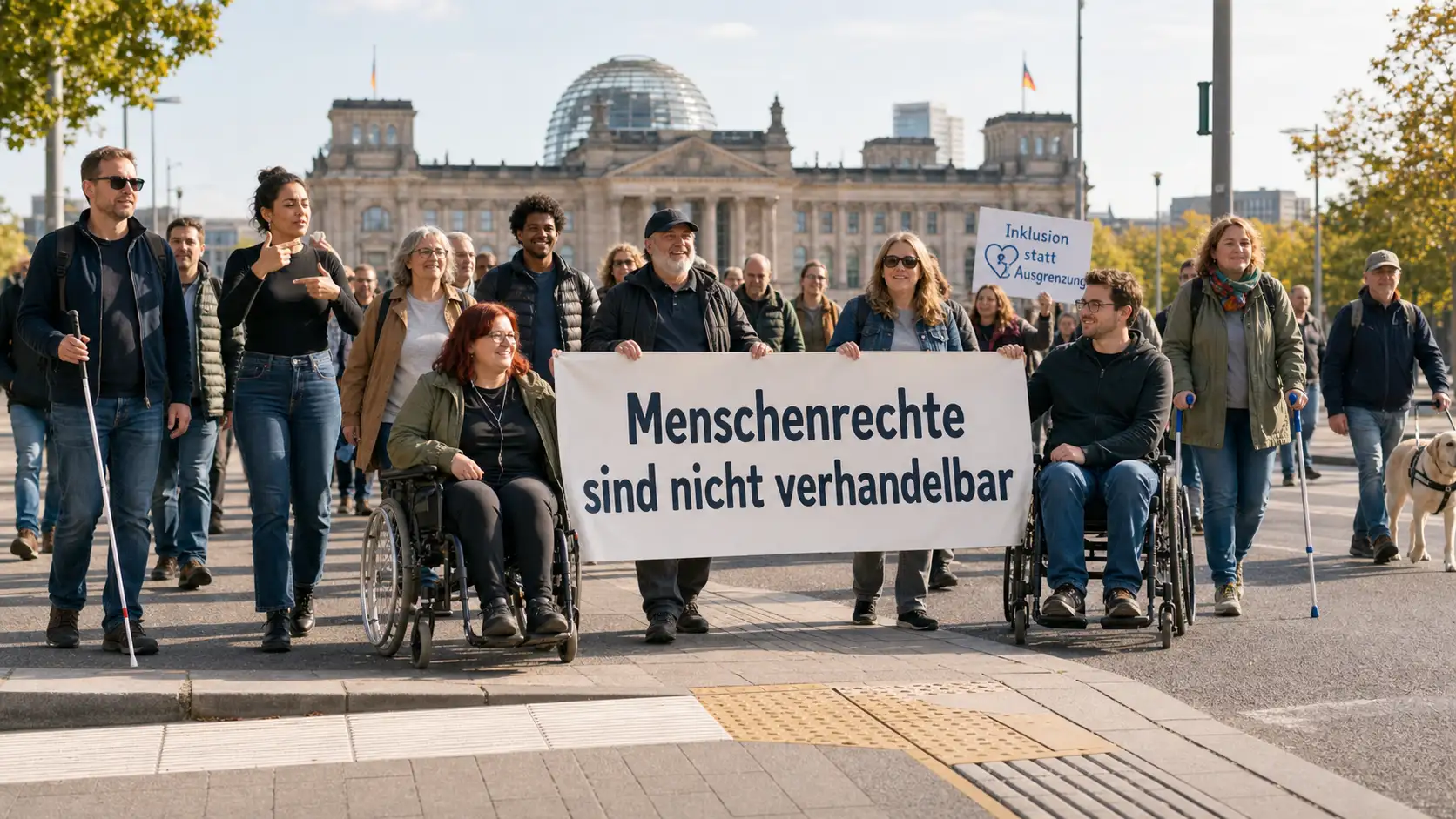
May 5 marks the European Day of Protest for the Equality of People with Disabilities. For more than 30 years, people with disabilities, self-advocacy organizations, associations, counseling centers, and supporters have used this day to make one thing visible: equality is not a special request. Accessibility is not a favor. Participation is not a luxury. It is about human rights.
This message is especially important this year. While politicians are discussing greater accessibility, debates about budget cuts are simultaneously emerging that could seriously jeopardize the participation of people with disabilities.
Reform of the Disability Equality Act: An Important Step
At the federal level, a reform of the Disability Equality Act (Behindertengleichstellungsgesetz, or BGG) is currently under discussion. In February 2026, the Federal Cabinet adopted a draft bill intended to improve accessibility in the public sector and establish stronger accessibility requirements in the private sector as well. The German Bundestag is set to discuss the proposal in early May 2026.
However, barriers do not exist only in government offices or public buildings — they are part of everyday life: at medical appointments, while shopping, in digital services, in restaurants, at events, in transportation, and in private services. Anyone who takes equality seriously cannot limit accessibility requirements to public institutions alone.
Disability organizations have therefore long been calling for binding regulations for private providers as well as stronger mechanisms to enforce existing rights. From Charter 22’s perspective, one thing is clear: a reform of the BGG must have a tangible impact on daily life. Accessibility can no longer be treated as a voluntary service but must be secured through effective legal protections.
Budget Cut Debates Threaten Participation
At the same time, a recent working paper by the federal government, the states, and municipal umbrella organizations has caused significant concern. The paper discusses potential savings in child and youth welfare services as well as integration assistance services. Advocacy groups warn of substantial cuts, restrictions on individual legal entitlements, and possible limitations to the right of choice and self-determination.
These proposals are not about abstract administrative costs. They directly affect children, young people, families, and people with disabilities. They concern school assistance, personal support services, help in daily life, participation in social life, and the ability to live independently.
Public budgets are undoubtedly under pressure. But financial challenges must not be addressed by weakening rights or imposing blanket limits on individual support needs. Integration assistance and child and youth welfare services are not optional extras. They safeguard education, development, protection, self-determination, and participation.
Participation Is Not a Cost Center
The current debate reveals a deeper underlying problem: people with disabilities are still too often viewed politically as a cost factor. Yet participation services make possible exactly what defines an inclusive society: attending school, vocational training, employment, housing, mobility, social relationships, culture, political participation, and living as part of society.
Cutting participation services does not simply save money. It risks exclusion, overburdening families, interrupted education, health consequences, social isolation, and ultimately even higher long-term costs. Above all, it endangers the right to equal participation.
That is why the central question should not be: “What does inclusion cost?” Instead, we should ask: what does it cost people and society when inclusion fails?
Our Position as Charter 22
Charter 22 stands for a society in which people with disabilities do not have to ask for participation, but can exercise their rights as a matter of course. This requires binding accessibility standards, reliable support services, and genuine participation in decision-making.
The European Day of Protest on May 5 reminds us that equality cannot wait. Not for better budget years. Not for complicated disputes over responsibilities. Not for future reforms.
We therefore call for the following: accessibility must become binding — in public spaces, digital services, healthcare, education, working life, and private services alike. Participation services must be secured and further developed according to individual needs. People with disabilities must be effectively involved in political decisions that affect their lives.
May 5 is a day of protest, but also a day of solidarity. It shows that people with disabilities and their allies are visible. They are many. And they will not be reduced to objects of care, budget items, or special-case solutions.
Equality is not an extra. Participation is a right. Human rights are not negotiable.